Correctness#
Correctness is checked at several independent levels: primitive operator algebra, sector dimensions, Hamiltonian matrix elements, analytic few-body spectra, sparse versus matrix-free action, and eigensolver residuals.
Operator algebra and sectors#
Small occupation spaces are compared directly with the canonical fermionic and bosonic relations,
Fixed-particle-number dimensions are checked against
and symmetry-constrained sectors are checked against the corresponding products of combinatorial factors. These tests establish the basis and primitive operator action before any model-specific Hamiltonian is constructed.
Analytic Hubbard dimer#
For the symmetric half-filled Hubbard dimer,
and the total double occupancy is
The numerical values coincide with the analytic curve across the plotted interaction range.
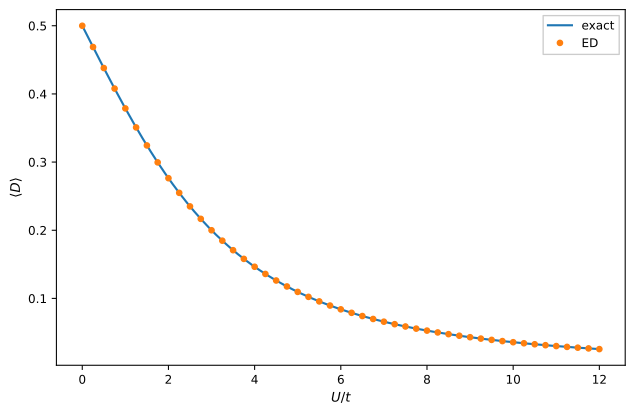
Total Hubbard-dimer double occupancy. The analytic curve and values obtained from the finite Fock-space Hamiltonian coincide across the plotted interaction range.#
The singlet-triplet gap provides a second check involving the low-energy spectrum,
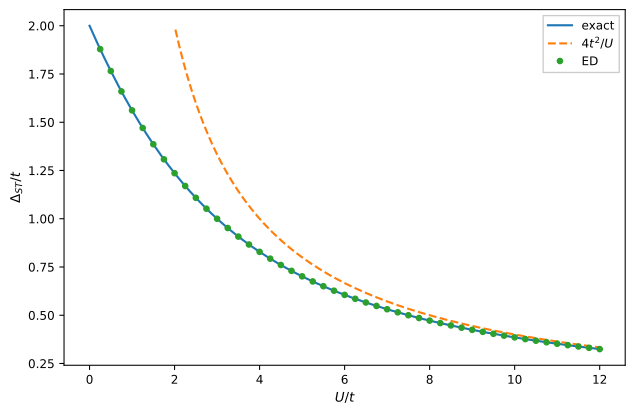
Hubbard-dimer singlet-triplet gap. The finite-matrix eigensolution follows the closed-form result and approaches the strong-coupling superexchange scale.#
The complete derivation and operator definitions are given in Hubbard dimer: charge fluctuations and superexchange.
Constrained Schwinger-boson spin space#
For one Schwinger boson on each of two sites, the constrained bosonic Fock space is four dimensional and represents two spin-\(1/2\) degrees of freedom. The Heisenberg Hamiltonian
has
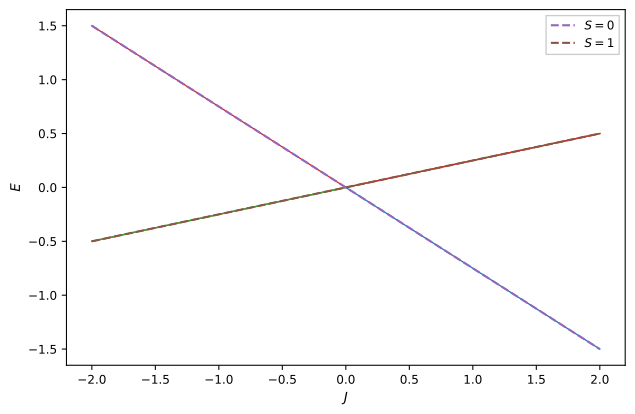
Constrained Schwinger-boson Heisenberg dimer. The four-state bosonic sector reproduces the analytic singlet and triplet branches.#
An independently constructed total-spin operator gives \(\langle S_{\mathrm{tot}}^2\rangle=0\) for the singlet and \(2\) for each triplet.
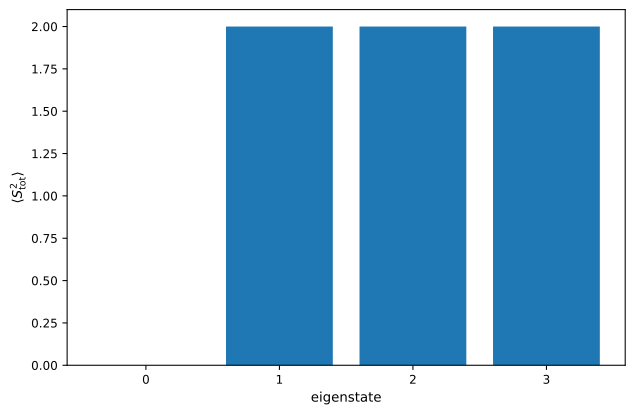
Total-spin expectation values at \(J=1\). The result identifies one singlet and the three states of the triplet manifold.#
The construction is shown in Schwinger bosons for a spin-1/2 Heisenberg dimer.
Independent Hamiltonian actions#
For a test vector \(x\), explicit sparse construction and matrix-free application are compared through
Real and complex operator families are tested in both statistics namespaces, including symmetry-constrained sectors. Compiled execution paths are compared against the NumPy implementation using the same represented Hamiltonian.
Eigensolver residuals#
Each returned Ritz pair can be checked with
Analytic agreement and small residuals test different failure modes: the former checks the model and operator algebra against an external result, while the latter checks convergence of the numerical eigenproblem actually solved.