Hubbard dimer: charge fluctuations and superexchange#
The half-filled Hubbard dimer is the smallest interacting fermion problem that contains both charge fluctuations and antiferromagnetic superexchange. It appears as the elementary bond problem behind strong-coupling expansions of the Hubbard model and provides a compact analytic benchmark for an exact-diagonalization calculation.[1]
The Hamiltonian is
with two fermions in four spin-orbitals. The fixed-particle-number sector therefore has dimension
Hamiltonian and eigensystem#
from edinpy import fermion as edf

UP, DOWN = 0, 1
t = 1.0
U = 4.0

site = edf.DoF(2, name="site")
spin = edf.DoF(2, name="spin")
modes = edf.FermionModes(site, spin)
sector = edf.NParticleSector(modes, N=2).build()

c = edf.set_notation(edf.Annihilation, modes)
cd = edf.set_notation(edf.Creation, modes)
n = edf.set_notation(edf.Number, modes)

H = 0
for sigma in (UP, DOWN):
    hop = cd(0, sigma) * c(1, sigma)
    H += -t * (hop + hop.dag)
for i in range(2):
    H += U * n(i, UP) * n(i, DOWN)

hamiltonian = edf.Hamiltonian(H, sector)
energies, _ = hamiltonian.eigsolve(k=None)
psi0 = hamiltonian.eigenstate(0)
The exact ground-state energy is
The low-energy singlet separates continuously from the charge-like singlet branches as repulsion grows.
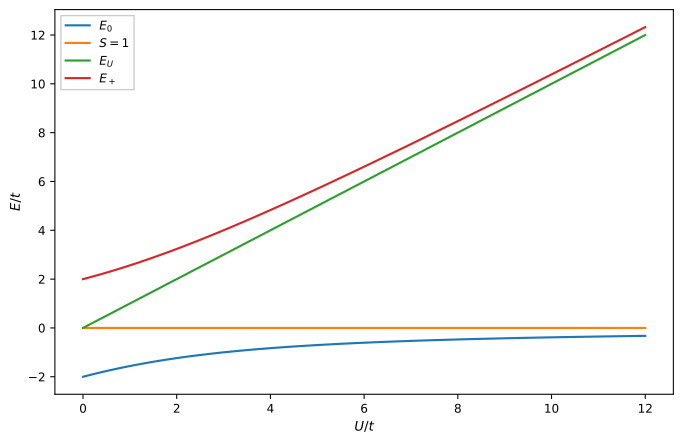
Complete \(N=2\) spectrum of the symmetric Hubbard dimer. The three triplet states remain degenerate at zero energy in this convention, while the correlated singlet ground state approaches the triplet manifold at strong coupling.#
Ground-state amplitudes#
The ground state can be inspected directly in the Fock basis through psi0.coefficients. At \(U/t=4\) the largest weights lie in the two singly occupied configurations with opposite spins, while the doublon-holon configurations retain smaller finite amplitudes.
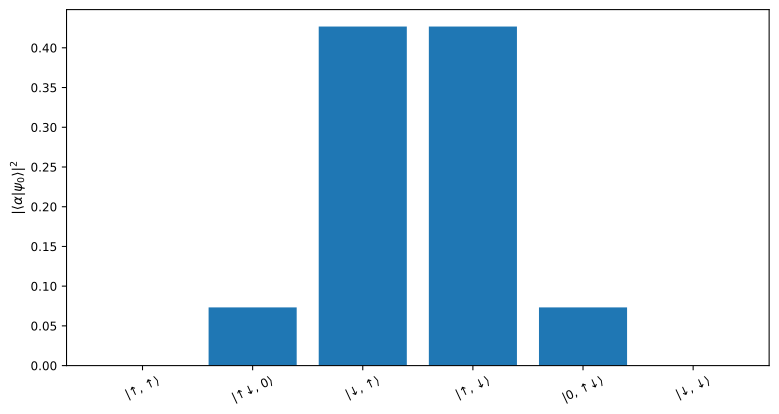
Ground-state Fock probabilities at \(U/t=4\). The singly occupied configurations dominate, while finite hopping keeps a nonzero doublon-holon admixture.#
Double occupancy#
The total doublon operator is
Its expectation value follows directly from the symbolic state algebra,
D = n(0, UP) * n(0, DOWN) + n(1, UP) * n(1, DOWN)
double_occupancy = psi0.dag * D * psi0
and the exact result is
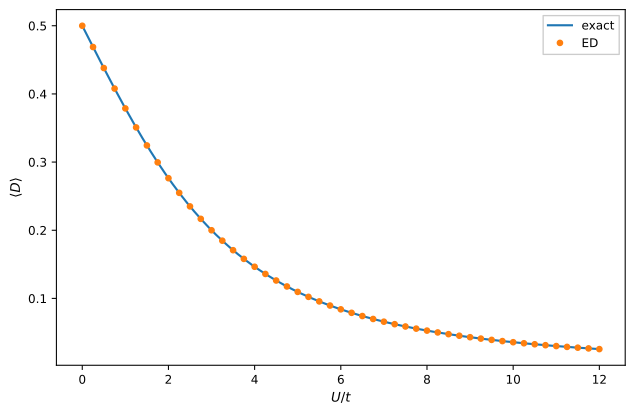
Total double occupancy of the half-filled dimer. Repulsion progressively removes doublon-holon weight from the ground state; exact diagonalization follows the analytic result throughout the crossover.#
Spin correlations#
The rotationally invariant bond correlation is
The operator is available as the exchange bilinear with unit coupling,
Sdot = edf.HeisenbergExchange(
    (0, UP), (0, DOWN),
    (1, UP), (1, DOWN),
    J=1.0,
    modes=modes,
)
spin_correlation = psi0.dag * Sdot * psi0
For the symmetric dimer,
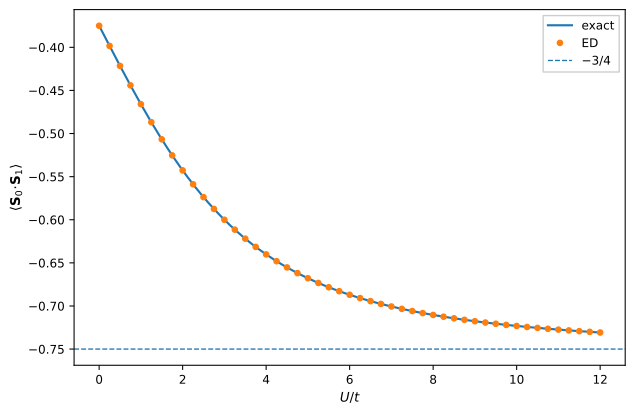
Bond spin correlation of the half-filled dimer. Suppressing charge fluctuations drives the ground state toward a pure two-spin singlet with \(\langle\mathbf S_0\cdot\mathbf S_1\rangle=-3/4\).#
Superexchange scale#
The triplet energy is \(E_T=0\) in the present convention, giving
At strong coupling,
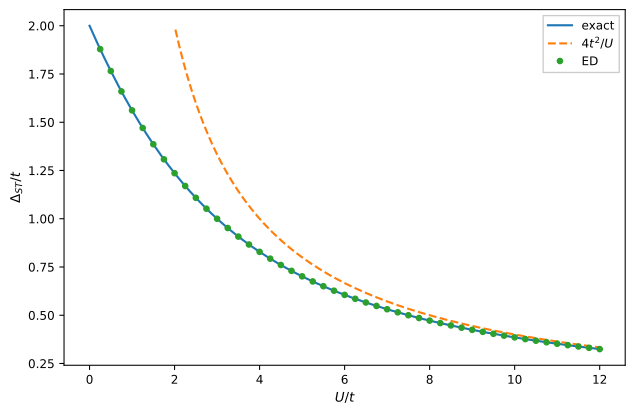
Singlet-triplet gap of the Hubbard dimer. The exact fermionic spectrum approaches the antiferromagnetic superexchange scale \(4t^2/U\) as charge excitations are pushed to high energy.#