Extended Hubbard ring: competing spin, charge, and bond correlations#
The one-dimensional extended Hubbard model adds a nearest-neighbor repulsion to the ordinary Hubbard Hamiltonian,
At half filling the thermodynamic model contains spin-density-wave, charge-density-wave, and bond-order-wave regimes.[1][2][3] A six-site ring cannot determine the phase boundaries, but it resolves the redistribution of finite-size correlations as \(V/t\) is increased at fixed \(U/t=4\).
Local operators for the three channels#
The staggered spin and charge operators are built from
The bond operator is
spin_z = [edf.SpinZ((i, UP), (i, DOWN), modes) for i in range(L)]
delta_n = [n(i, UP) + n(i, DOWN) - 1 for i in range(L)]

bond = []
for i in range(L):
    j = (i + 1) % L
    B = 0
    for sigma in (UP, DOWN):
        hop = cd(i, sigma) * c(j, sigma)
        B += hop + hop.dag
    bond.append(B)
For any local field \(O_j\),
For the bond channel the disconnected contribution \(|\langle B_q\rangle|^2/L\) is subtracted.
Spin response#
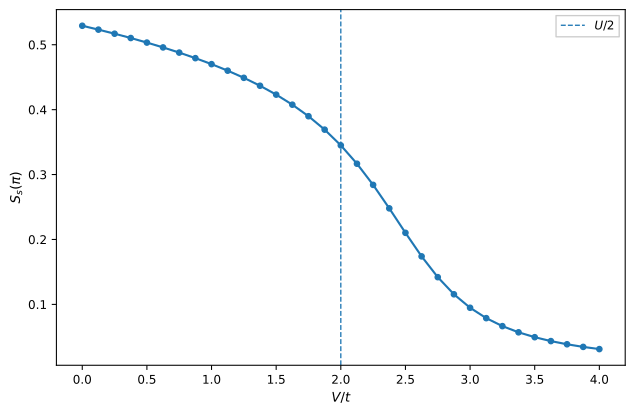
Staggered spin structure factor at \(U/t=4\). Increasing nearest-neighbor repulsion weakens the spin-dominated response of the small ring as the system approaches the charge-dominated side.#
Charge response#
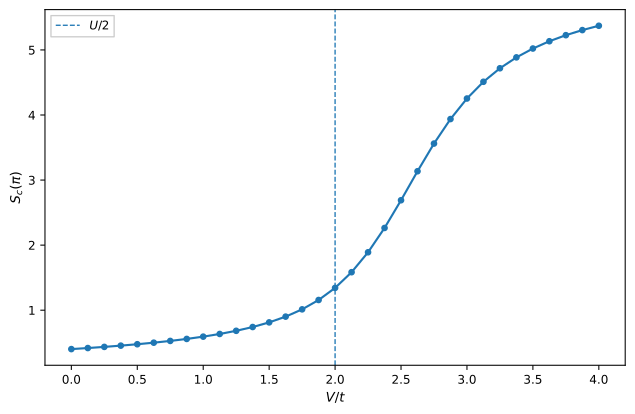
Staggered charge structure factor at \(U/t=4\). The strong growth near and beyond the reference line \(V=U/2\) reflects the increasing tendency toward alternating high- and low-density sites.#
Bond fluctuations#
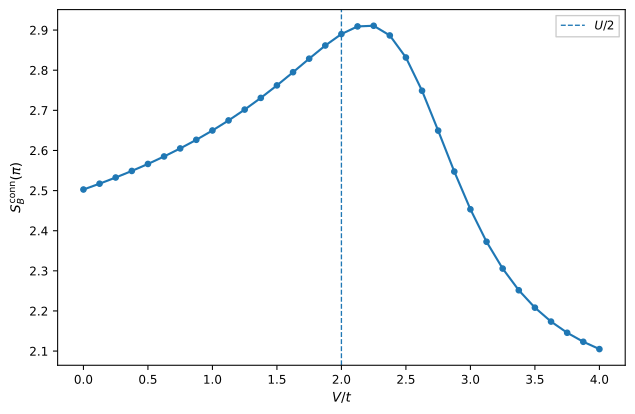
Connected staggered bond structure factor. The enhanced bond fluctuations near the spin-charge competition region are the finite-cluster signature most closely associated with the bond-order-wave regime found in larger systems.#
Double occupancy#
The site-averaged doublon density is
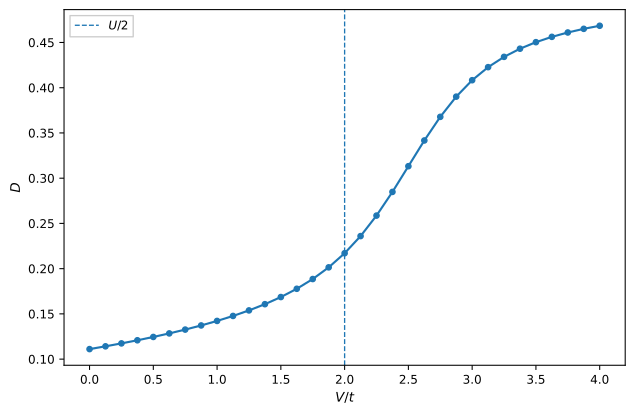
Double occupancy at \(U/t=4\). On the charge-dominated side, doublons become favorable because an alternating doublon-rich and low-density pattern reduces the nearest-neighbor repulsion.#
Taken together, the four observables separate the three competing tendencies of the finite ring. At small \(V/t\), the staggered spin response is largest and doublon density remains suppressed. Around the spin-charge competition region, the spin response falls before the charge response has fully saturated, while connected bond fluctuations are enhanced. At larger \(V/t\), the staggered charge response and double occupancy rise together. The broad crossover and the locations of the extrema are finite-size properties, not estimates of thermodynamic phase boundaries.
Momentum profiles#
The discrete momenta of the six-site ring show where the spectral weight accumulates. The three couplings below sample the spin-dominated side, the competition region, and the charge-dominated side.
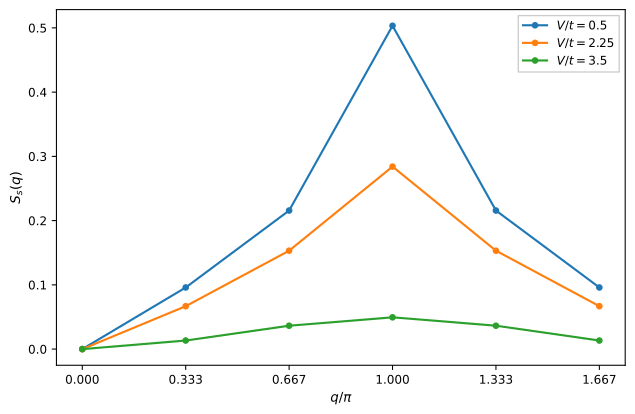
Momentum-resolved spin structure factor. The \(q=\pi\) peak is strongest on the low-\(V\) side and loses weight as charge ordering becomes favorable.#
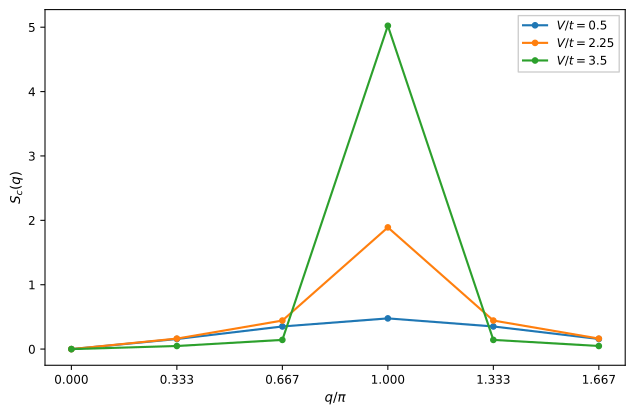
Momentum-resolved charge structure factor. The \(q=\pi\) component becomes dominant on the high-\(V\) side.#
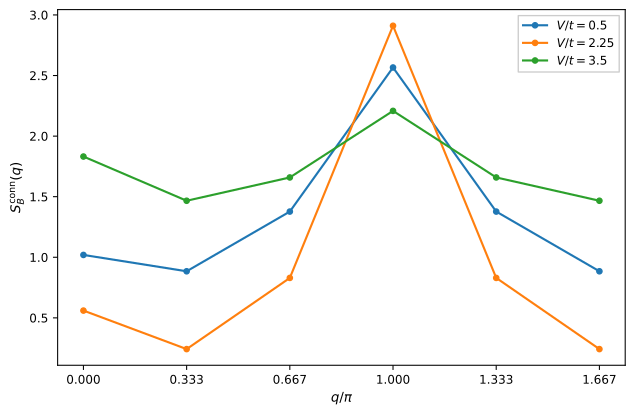
Connected bond structure factor. The staggered bond channel is enhanced most strongly in the intermediate coupling region of the finite ring.#
The finite-size extrema should not be interpreted as thermodynamic phase boundaries. They show instead how spin, charge, and bond fluctuations exchange spectral weight across the competition region.