Heisenberg dimer in a constrained fermionic Hilbert space#
Exchange Hamiltonians describe the low-energy spin dynamics of Mott insulators, quantum magnets, and Hubbard systems after high-energy charge fluctuations are integrated out. For two spin-\(1/2\) sites,
The local spin operators are represented by fermionic bilinears,
A pure two-spin problem occupies the subspace with exactly one fermion on each site. The local-occupancy constraint reduces the \(N=2\) Fock sector from six states to four.
from edinpy import fermion as edf

UP, DOWN = 0, 1

site = edf.DoF(2, name="site", labels=("left", "right"))
spin = edf.DoF(2, name="spin", labels=("up", "down"))
modes = edf.FermionModes(site, spin)

sector = (
    edf.NParticleSector(modes, N=2)
    .project_particles("site", left=1, right=1)
    .build()
)

Sdot = edf.HeisenbergExchange(
    (0, UP), (0, DOWN),
    (1, UP), (1, DOWN),
    J=1.0,
    modes=modes,
)
The analytic energies follow from
so that
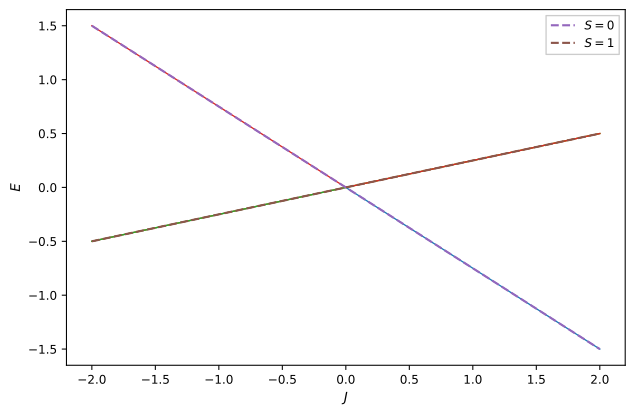
Spectrum of the two-spin Heisenberg dimer. Antiferromagnetic \(J>0\) selects the singlet, while ferromagnetic \(J<0\) selects the triplet manifold.#
Total-spin diagnostic#
The total-spin operator can be constructed literally from the summed raising, lowering, and \(z\) components,
Splus = sum(
    (edf.SpinPlus((i, UP), (i, DOWN), modes) for i in range(2)),
    start=0,
)
Sminus = sum(
    (edf.SpinMinus((i, UP), (i, DOWN), modes) for i in range(2)),
    start=0,
)
Sz = sum(
    (edf.SpinZ((i, UP), (i, DOWN), modes) for i in range(2)),
    start=0,
)
S2 = Sz * Sz + 0.5 * (Splus * Sminus + Sminus * Splus)
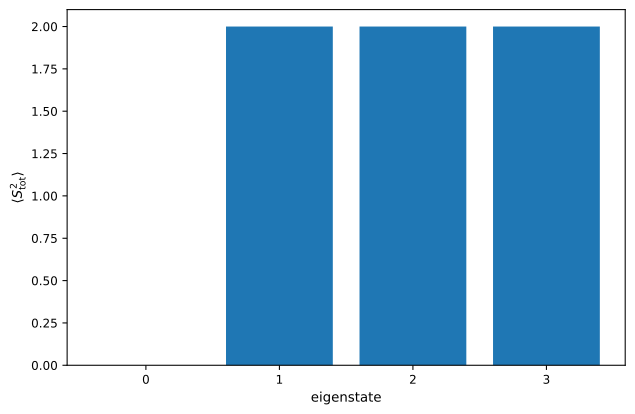
Total-spin quantum number at \(J=1\). The singlet has \(\langle S_{\mathrm{tot}}^2\rangle=0\) and the three triplets have \(\langle S_{\mathrm{tot}}^2\rangle=2\).#
The occupancy constraint removes the doublon-holon states and leaves the four-dimensional effective spin Hilbert space.