QUARTIC2D#
QUARTIC2D: Quadrature for Radial Tetra-center Interaction Coefficients in 2D
Four-center interactions for localized states in two dimensions
Localized-orbital models of two-dimensional materials often require Coulomb matrix elements in generalized orbital bases built from Wannier functions, atomic-like orbitals, defect states, quantum-dot states, or other localized wavefunctions. These matrix elements set the interaction parameters of Hubbard-like and multiorbital Hamiltonians, including direct terms, exchange, pair hopping, and correlated hopping. The calculation becomes more demanding when the orbitals are anisotropic or complex, when dielectric screening is nonlocal, or when many separations and orbital combinations must be evaluated.
QUARTIC2D evaluates the corresponding four-center interaction matrix elements
for localized two-dimensional orbitals and translationally invariant radial kernels. The four orbital indices enter through two transition fields,
The transition fields may be real or complex. Their index pattern determines the physical matrix element. Direct interactions, exchange, pair hopping, correlated hopping, and other four-index channels use the same numerical formulation.
QUARTIC2D expands each transition field in circular harmonics, Hankel-transforms the radial coefficients, and evaluates the remaining momentum integrals for the requested separation vectors. The factorization separates orbital structure, relative geometry, and the radial interaction kernel while retaining anisotropic and complex orbital products explicitly.
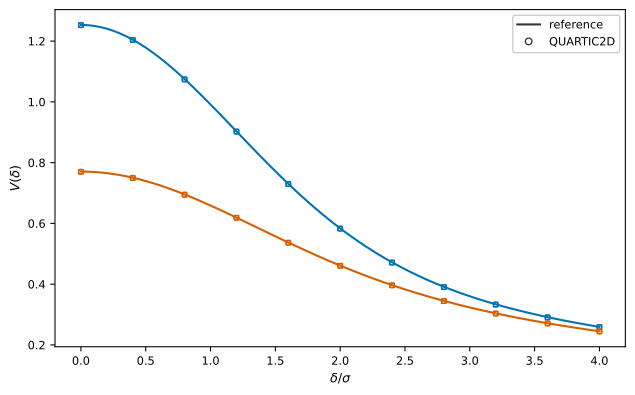
Bare Coulomb and Rytova–Keldysh matrix elements [Keldysh, 1979, Rytova, 1967] for the isotropic Gaussian calculation in Getting started. Blue denotes the Coulomb kernel and orange denotes the Rytova–Keldysh kernel. Solid curves show the analytic matrix elements, open circles show the default QUARTIC2D calculation, and open squares show the self-converged QUARTIC2D calculation. Screening primarily reduces the short-distance matrix element.#
Install QUARTIC2D and evaluate an isotropic Gaussian with bare Coulomb and Rytova–Keldysh kernels.
Four-center inputs, transition fields, displacements, transformed harmonics, convergence, diagnostics, and numerical-method guidance.
Object-oriented API reference with separate pages for public classes, convergence results, and callable methods.
Analytic transforms, direct and exchange channels, anisotropy, sampled Cartesian data, complex transition fields, dielectric screening, and long-range interactions.
Four-center reduction, Fourier conventions, angular harmonics, signed Bessel orders, and the final interaction formula.
Mathematical, implemented, validated, and recommended scope, including the assumptions on radial kernels and represented momentum support.
Independent reference accuracy, automatic-refinement behavior, end-to-end tests, timing, scaling, and memory measurements.
Primary references for the physical kernels and numerical methods named throughout the documentation.
What QUARTIC2D is for#
The package is intended for localized 2D orbitals, Wannier functions, bound states, defect states, moiré states, and other scalar fields for which the interaction kernel depends only on the in-plane separation. A calculation may use identical fields, two different densities, or complex transition fields built from different orbitals.
For example, the same four-center expression contains
for a direct density-density term and
for exchange. Pair hopping and correlated hopping follow from other choices of the four orbital indices. QUARTIC2D does not restrict the transition fields to positive densities.
The current spatial reduction assumes a scalar radial kernel \(U(q)\) in momentum space. Genuinely anisotropic, tensor-valued, or non-translationally-invariant spatial kernels require a different reduction. See Limitations and scope for the precise package scope.
Numerical control#
Ordinary constructors provide practical defaults and inexpensive diagnostics. When a calculation requires an explicit numerical criterion, HarmonicTransform.converge_parameters(...) and Interaction.converge_parameters(...) refine the represented transform and assembled interaction and record the selected parameters. Both convergence-result objects provide plot_convergence() for inspecting the search, and objects constructed from those results retain the same record. Their rtol values are self-convergence criteria, not pointwise error bounds against an unknown exact solution. For repeated calculations, settings may be reused after the intended field, kernel, and displacement family has been checked.
See Choosing numerical methods for default and specialist-method guidance, Convergence and diagnostics for automatic convergence and parameter reuse, and Benchmark matrix for the exact equations behind the validation suite.