Validation and benchmarks#
QUARTIC2D separates mathematical checks, numerical accuracy, automatic-convergence reliability, end-to-end validation, timing, and memory. The benchmark definitions are public and are part of the documentation because the practical recommendations in the User Guide are based on them.
Exact field profiles, analytic transforms, kernel equations, displacement domains, and construction of the 74-case interaction matrix.
Independent references, automatic self-convergence, numerical-method capability, mixed-parity coverage, and end-to-end errors.
Calibration cost, qualified fixed-production timing, runtime scaling, and peak-memory measurements.
Canonical commands, result files, provenance requirements, and subset runs.
What is tested#
The broad interaction study uses 74 field/kernel combinations at the primary Interaction.rtol = 1e-4 target. Its inputs include smooth Gaussian harmonics, odd angular pairs, anisotropy through \(m=\pm2\) and \(m=\pm4\), nodal fields, a complex mixed-parity field, a radial cusp, an oscillatory exponential, and algebraic tails. Kernel families include Coulomb, three Rytova-Keldysh screening lengths, single and dual gates, Thomas-Fermi, three Yukawa scales, a strictly two-dimensional Helmholtz/Yukawa Green function, interlayer and gated-interlayer Coulomb, and the nonanalytic static 2DEG RPA/Stern kernel [Stern, 1967].
The exact equations and parameter values are collected in Benchmark matrix and are referenced throughout the User Guide.
Independent accuracy and selector behavior#
The end-to-end benchmark begins with analytic two-dimensional fields sampled on a Cartesian grid, decomposes those arrays with PETAL2D, calibrates the momentum-space representation, and evaluates the final interaction against analytic momentum-space form factors.
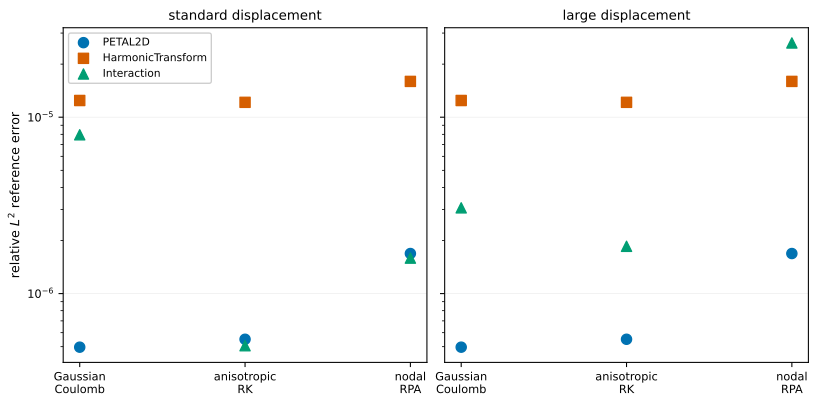
Case-resolved relative \(L^2\) reference errors for the three end-to-end pipelines in the standard and large-displacement domains. PETAL2D profile error, HarmonicTransform error, and final Interaction error are shown as separate markers for each physical case; no line connects independently selected suite maxima.#
Automatic selection is evaluated separately from independent accuracy. The four-case canonical matrix records whether each selector accepted, refused conservatively, missed a demonstrably capable point, or exhausted the declared search box without finding one. See Accuracy and automatic convergence for the case-level status matrix and the broader 74-case reference study.