Preparing transition fields#
The four orbital indices enter QUARTIC2D through two localized transition fields,
PETAL2D represents each transition field by radial circular harmonics. These
radial functions are the real-space input to HarmonicTransform.
Callable fields#
For analytic or callable orbitals, construct the transition field directly. The following normalized two-dimensional Gaussian orbitals produce an odd \(s\)–\(p_x\) transition field:
import numpy as np
from petal2d import PolarDecomposition


def orbital_s(x, y):
    return np.exp(-0.5 * (x**2 + y**2)) / np.sqrt(np.pi)


def orbital_px(x, y):
    return np.sqrt(2.0 / np.pi) * x * np.exp(-0.5 * (x**2 + y**2))


def rho_sp(x, y):
    return np.conj(orbital_s(x, y)) * orbital_px(x, y)

x = np.linspace(-6.0, 6.0, 181)
y = np.linspace(-6.0, 6.0, 181)

dec_sp = PolarDecomposition(
    rho_sp,
    x,
    y,
    Nr=181,
    Ntheta=256,
    rmax=5.5,
    origin=(0.0, 0.0),
)

print(dec_sp.m_sorted)
For this real field PETAL2D retains the conjugate \(m=\pm1\) pair, up to the exact ordering used by the PETAL2D version.
The chosen origin defines the angular expansion center. It must be consistent with the centers used when the displacement vectors are defined.
Inspect the representation before transforming#
PETAL2D exposes plotting helpers that should normally be used before moving to QUARTIC2D. The radial-harmonic view shows which modes were retained and how their power is distributed:
fig, axes = dec_sp.plot_harmonics_with_hist(
    title=r"$s$--$p_x$ transition field"
)
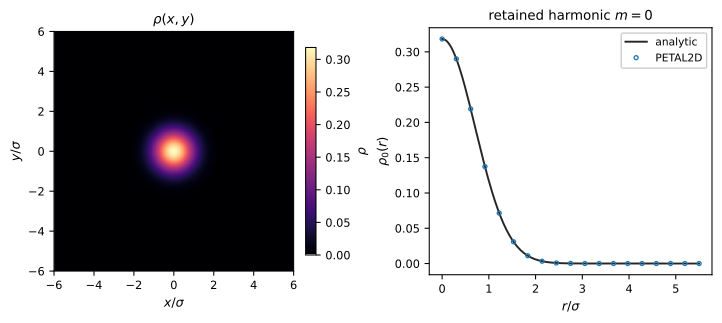
A simple retained-harmonic plot from PETAL2D. The same helper should be used on more complicated transition fields before any QUARTIC2D calculation is attempted.#
The original/reconstructed-field view is useful for sampled, anisotropic, or sign-changing fields:
fig, axes = dec_sp.plot_original_vs_reconstructions()
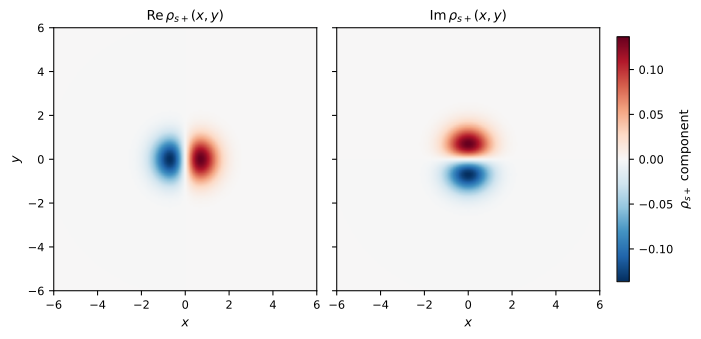
A sampled transition field and its PETAL2D reconstruction. This is the plot to inspect when the input comes from numerical grid data rather than an analytic callable.#
These plots are not substitutes for the scalar diagnostics. Record the actual reconstruction and represented-domain checks as well:
print(f"reconstruction error [%]: {dec_sp.recon_error_measured:.3e}")
print(f"domain consistency: {dec_sp.domain_consistency:.8f}")
print("retained harmonics:", dec_sp.m_sorted)
recon_err_tol and PETAL2D’s reconstruction-error attributes are expressed in
percent. For example, recon_err_tol=1e-2 means a target of
\(10^{-2}\%\), not a dimensionless relative error of \(10^{-2}\).
Sampled numerical fields#
For orbitals obtained numerically, first form the transition field on a common uniform Cartesian grid:
rho_ij = np.conj(psi_i) * psi_j

dec_ij = PolarDecomposition(
    rho_ij,
    x,
    y,
    interp_method="cubic",
)
dec_ij.recon_error_measured measures the retained-harmonic reconstruction on
the polar grid. dec_ij.domain_consistency compares represented polar-domain
power with the Cartesian input power. These checks precede QUARTIC2D refinement:
downstream momentum-space calculations cannot reconstruct information absent
from the sampled field.
The PETAL2D documentation gives the exact array-shape, Cartesian-grid, centering, and interpolation requirements. The QUARTIC2D sampled-data example in Sampled transition fields on a Cartesian grid shows the array-to-interaction path, including an independent analytic transform comparison before the four-center calculation.
Angular expansion#
PETAL2D represents
A real field has conjugate \(+m\) and \(-m\) channels. A complex transition field need not. This is why the two transition fields in a general four-center matrix element should not be treated as ordinary positive densities.
If the first and second fields contain \(N_m^{(1)}\) and \(N_m^{(2)}\) retained harmonics, the final interaction contains
harmonic pairs. Angular truncation therefore affects both represented field accuracy and downstream cost.
What to check before transforming#
Before building HarmonicTransform, inspect:
the requested and measured PETAL2D reconstruction error.
retained harmonics and their power fractions.
domain_consistency.radial support/cutoff diagnostics.
angular and radial sampling limits.
the field visually when interpolation, centering, nodes, or complex phase are important.
A QUARTIC2D convergence result concerns the numerical transform of the field PETAL2D supplied. It does not establish the accuracy of the upstream electronic-structure calculation, finite Cartesian domain, orbital sampling, or PETAL2D interpolation.
For related orbital families, determine reusable settings from the difficult or spatially extended members rather than assuming that one field represents the entire family. See Calibrate families, not every point.