Direct and exchange couplings in a two-orbital localized basis#
Multiorbital effective Hamiltonians require more than an onsite or intersite density-density repulsion. Distinct orbital products generate exchange and other off-diagonal four-center terms, and sign changes in those products are part of the physical matrix element rather than a numerical pathology.
A two-orbital basis already contains this distinction. Consider the normalized orbitals
For the direct channel, the transition fields are
whereas exchange uses
The latter changes sign across the \(p_x\) node. The interaction kernel is the regular two-dimensional Yukawa form
Angular content#
The analytic angular structure is
The executable example constructs all three decompositions and records the measured PETAL2D reconstruction errors reported below.
For an interactive calculation, PETAL2D and QUARTIC2D provide the relevant inspection helpers directly:
dec_sp.plot_harmonics_with_hist("Exchange transition field")
hcal_sp.plot_convergence()
field_sp.plot_harmonics()
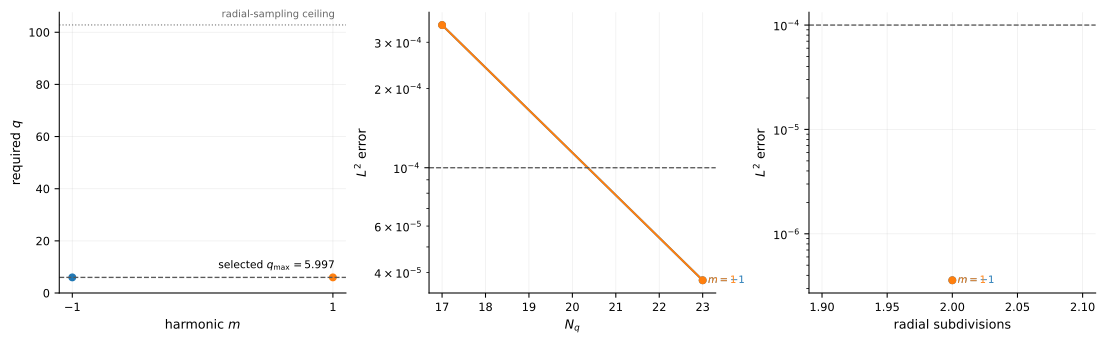
Self-convergence diagnostics for the exchange transition-field transform.#
Direct and exchange interactions#
After separately calibrating the three harmonic transforms, calibrate the two interaction channels on the production displacement domain:
direct_cal = Interaction.converge_parameters(
    calibration_vectors,
    field_ss,
    field_pp,
    yukawa,
    rtol=1.0e-4,
    atol=1.0e-12,
    method="gl4",
    verbose=False,
)
exchange_cal = Interaction.converge_parameters(
    calibration_vectors,
    field_sp,
    field_sp,
    yukawa,
    rtol=1.0e-4,
    atol=1.0e-12,
    method="gl4",
    verbose=False,
)

exchange_cal.plot_convergence()
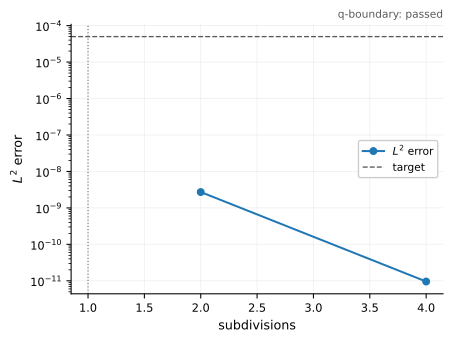
Self-convergence diagnostics for the exchange interaction calibration.#
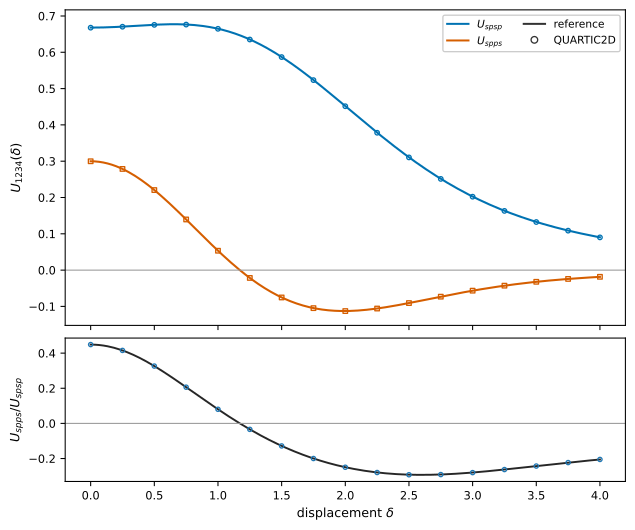
Direct and exchange matrix elements from the same localized orbital pair. The upper plot compares independent reference curves with QUARTIC2D values; the lower plot shows the exchange-to-direct ratio. The sign change of the exchange channel follows from the nodal transition field and is a genuine four-center effect rather than a numerical artifact.#
PETAL2D
rho_ss: modes=[0], reconstruction error=1.377e-14%
rho_pp: modes=[0, 2, -2], reconstruction error=3.233e-14%
rho_sp: modes=[1, -1], reconstruction error=2.852e-14%

Automatic convergence
all harmonic searches satisfied: True
direct interaction satisfied: True
exchange interaction satisfied: True
delta=0.0  direct=+0.667798  exchange=+0.299776
delta=1.0  direct=+0.664678  exchange=+0.053394
delta=2.0  direct=+0.451379  exchange=-0.112760
The complete script is examples/four_center_interaction.py. Field
preparation, transform convergence, and interaction convergence are reported
separately for the two channels.