Long-range Coulomb matrix elements between distant localized states#
Extended Hubbard and other long-range lattice models require interaction matrix elements beyond the nearest neighbor. Establishing where those terms can be truncated means evaluating the interaction over several lattice spacings, where the matrix element is small but may still influence collective behavior.
Large separations also make the translation factor highly oscillatory in momentum space. A normalized Gaussian with the bare Coulomb kernel provides an analytic reference while exposing this numerical regime.
For
the exact interaction is
implemented stably with scipy.special.i0e. At large separation,
Calibrate the represented field first#
The harmonic transform is calibrated independently of the later large-\(\delta\) interaction:
hcal = HarmonicTransform.converge_parameters(
    dec,
    rtol=1.0e-4,
    atol=1.0e-12,
    q_tail_rtol=1.0e-3,
    method="simpson",
    verbose=False,
)
field = hcal.transform(dec)
hcal.plot_convergence()
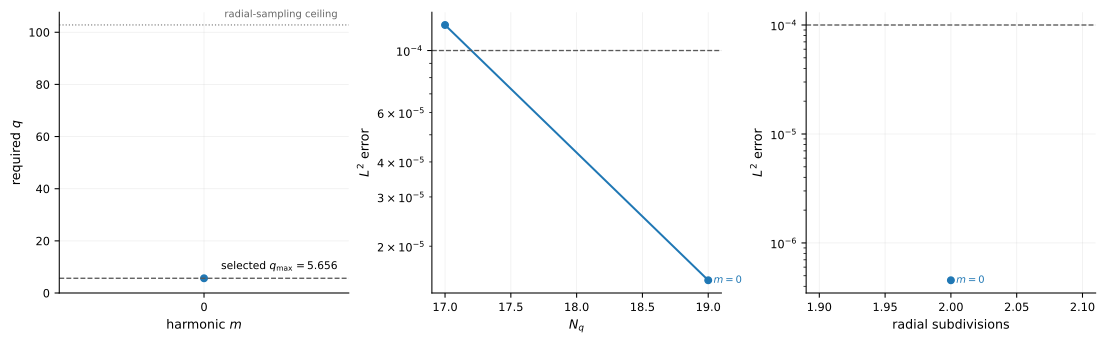
Self-convergence diagnostics for the represented Gaussian field.#
Again, the independent analytic error and the internal refinement target are different quantities.
Evaluate the oscillatory interaction#
The production domain spans
A finite GL4 sequence is calibrated directly on that domain:
gl4_cal = Interaction.converge_parameters(
    vectors,
    field,
    field,
    coulomb,
    rtol=1.0e-3,
    atol=1.0e-12,
    method="gl4",
    subdivisions=(32, 64, 128, 256, 512, 1024),
    verbose=False,
)
gl4 = gl4_cal.interaction(vectors, field, field, coulomb)
gl4_cal.plot_convergence()
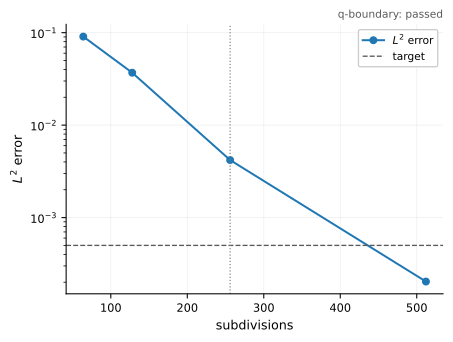
Self-convergence diagnostics for the GL4 large-separation interaction.#
FFTLog [Hamilton, 2000] is also evaluated as a specialist oscillatory method. Ogata quadrature [Ogata, 2005] is attempted
only when the optional hankel dependency is installed.
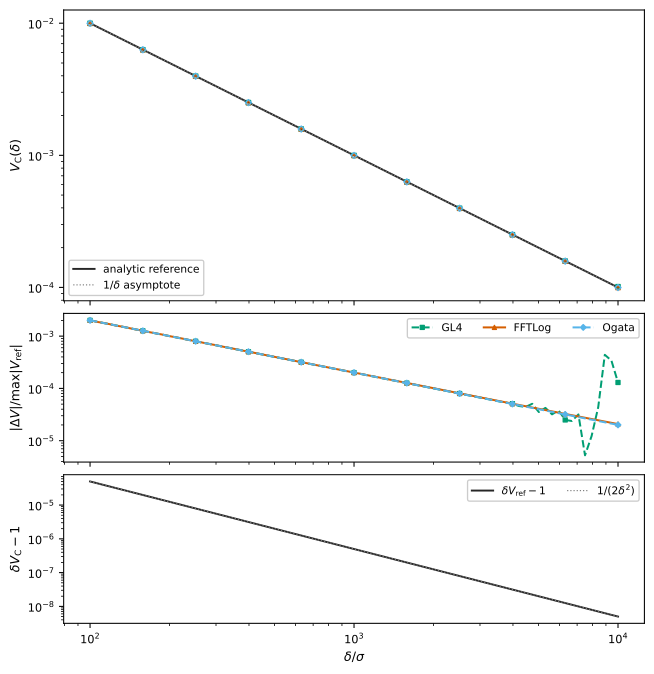
The upper plot compares GL4, FFTLog, and Ogata evaluations with the analytic Gaussian Coulomb interaction and its \(1/\delta\) asymptote. The middle plot shows the pointwise absolute residual normalized by the peak analytic interaction. The lower plot shows the finite-separation correction \(\delta V_{\mathrm{C}}-1\) and its leading asymptotic form. The purpose is to expose the oscillatory regime and validate specific configurations, not to establish a universal method ranking.#
HarmonicTransform
self-convergence satisfied: True
analytic relative L2 error: 7.486e-04

Large-distance interaction
GL4 self-convergence satisfied: True
GL4 independent relative L2 error: 2.012e-03
FFTLog independent relative L2 error: 2.005e-03
Ogata independent relative L2 error: 2.003e-03
delta=    100  delta*V_exact=1.000050011
delta=   1000  delta*V_exact=1.000000500
delta=  10000  delta*V_exact=1.000000005
The complete script is examples/large_separation.py. Publication-scale method
coverage and timing studies are kept separately in Validation and benchmarks.